
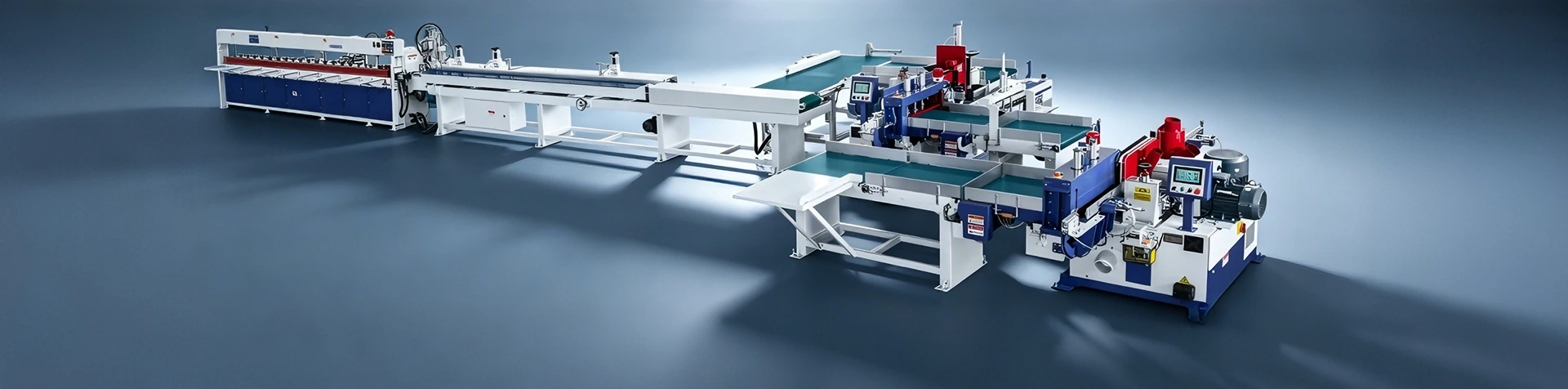
Semi-Automatic Square-Tooth Timber Joining Equipment Lines
In modern woodworking, efficient and reliable joining solutions define the throughput and quality of engineered timber production. Our range of square-tooth processing assemblies blends manual oversight with automated precision, striking an ideal balance for workshops scaling their output. The lineup includes dedicated Semi-Auto Wood Tenon Splicing Assembly Lines that streamline end-to-end tenon cutting and gluing, allowing operators to control feed rates while pneumatic clamping ensures joint accuracy. These are complemented by Half-Automated Timber Finger Joint Processing Systems, where vertical and horizontal profiling heads shape the characteristic finger profile with repeatable precision, and the semi-automatic glue application eliminates waste. For structural interlocking applications, our Partially Automatic Wooden Interlock Tenon Production Chains integrate notching, grooving, and cross-cutting stations into a coherent flow, producing ready-to-assemble components for beams and posts. Supporting this ecosystem are compact Half-Auto Wood Notch Splicing Manufacturing Units, designed for smaller batch runs and corner-locking joints, where digital length measurement and automatic stack feeding reduce handling time by up to 40%. Each subsystem shares common control interfaces, making the entire square-tooth joining process seamless from raw timber to cured block.
The Semi-Automatic Square-Tooth Timber Joining Equipment Lines are engineered as a modular configuration that adapts to hardwoods, softwoods, and engineered composites. The square-tooth profile outperforms conventional finger profiles in load-bearing scenarios by distributing stress across a larger bond area, making it ideal for laminated beams, window scantlings, and structural glulam. Operators manage the infeed alignment, while the servo-driven spindles execute multi-axis profiling with tolerances held to ±0.15 mm. Material handling between stations uses timed conveyor segments that can be paused for visual inspection without disrupting the cycle. The integrated cold-curing adhesive system features dual-component mixing heads and anti-drip valves, reducing consumption by 12–18% compared to standalone applicators. Quick-change tooling cartridges allow profile switchover in under eight minutes, a key advantage for shops handling diverse timber dimensions. Below are the core operational specifications and feature highlights.
| Parameter | Specification |
|---|---|
| Max workpiece width | 350 mm (standard), 450 mm (reinforced frame) |
| Timber thickness range | 15–120 mm |
| Profiling motor power | 4 kW × 2 spindles (8 kW total) |
| Spindle speed | 6,000 rpm, inverter-controlled |
| Feed speed (adjustable) | 5–22 m/min |
| Square-tooth pitch options | 16 mm, 20 mm, 25 mm |
| Glue system | Cold-cure PVA/PUR capable, 2-component |
| Air consumption | 0.6–0.8 MPa, 180 L/min |
| Overall line length | 12.5 m (sub-configurable) |
| Control interface | Touchscreen PLC with recipe memory |
- Adjustable pneumatic clamping force from 800 to 2200 N for varying wood densities.
- Automatic fault detection on misaligned boards prevents tool damage and waste.
- Integrated dust extraction ports (Ø120 mm) maintain clean cutting pockets.
- Step-by-step assembly mode allows single-block production for prototyping.
- Vision alignment lasers guide the operator during initial tooling setup.
- Modular design permits future addition of CNC end-trimming or branding stations.
Beyond the tabletop numbers, the true value lies in how the Semi-Automatic Square-Tooth Timber Joining Equipment Lines reshape daily workflows. A single qualified operator can oversee infeed, profiling, glue application, and press-out, with machine pacing preventing fatigue-related errors. The square-tooth geometry requires 25% less clamping pressure during curing compared to traditional finger joints, accelerating cycle times and saving energy. Timber offcuts that would typically be discarded can now be converted into premium-grade jointed stock, directly improving material yield. Service access panels are positioned on both flanks, so maintenance teams can service bearings and belts without dismantling peripheral conveyors. The control software logs operational hours, glue usage, and joint counts, giving production managers clear insight for scheduling and cost tracking. For joinery businesses eyeing export markets, the consistent joint strength meets EN 14080 and ASTM D5572 benchmarks without requiring supplementary fasteners. Whether producing laminated posts for timber-frame housing or high-frequency spliced panels, this equipment family delivers the repeatability and control that bridge the gap between manual artistry and full automation.
Related Products




Hot Products

Fully Automatic Infinitely Long Finger Jointing Production Lines(Automatic Stacking And Collecting System)
Yongqiang Futai is the manufacturer of Automatic Stacking And Collecting System Lines. This Fully Automatic Infinitely Long Finger Jointing Production Lines(Automatic Stacking And Collecting System) is a high-end intelligent equipment designed for efficient splicing of solid wood short materials, unlimited long continuous production and automatic collection of finished products. It is specifically tailored for furniture manufacturing, construction wood forms, and integrated material processing industries. As the core product of Yongqiang Futai's deep engagement in wood processing automation, this production line integrates precise mechanical transmission, intelligent numerical control control and modular design, achieving fully automated operations from short material loading, comb teeth splitting and gluing, unlimited long pressing and cutting to automatic stacking and finished product collection. It completely resolves the pain points of low efficiency in traditional tooth joint technology, high labor costs, unstable splicing accuracy and cumbersome finished product collection.
Finger Jointers
As a professional source manufacturer specializing in the research and development, precision manufacturing, and global cross-border export of Finger Jointers, Yongqiang Futai focuses on the technology research and quality upgrading of solid wood tooth joint processing equipment, and creates a series of high-performance woodworking tooth joint machine products, covering multiple fully automatic and semi-automatic models. It provides professional, efficient, and high-precision solutions for wood comb teeth, tenoning, and tooth joint processing for global wood processing plants, furniture production enterprises, construction wood square processing plants, and waste wood recycling merchants.
Semi-Automatic Finger Joint
Semi-Automatic Finger Joint is a mid-range, cost-effective toothed jointing and pressing equipment specially developed by Yongqiang Futai Manufacturer for small and medium-sized wood processing factories, wood form refurbishment enterprises, and individual workshops worldwide. It combines the advantages of manual auxiliary positioning and mechanical hydraulic automatic pressing, balancing the industry pain points of low efficiency of manual models, high cost of fully automatic models, and complex operation and maintenance. It is the core main production equipment for the after-toothing and lengthening and shaping of wood.
Horizontal Auto Finger Jointing Lines
Yongqiang Futai Horizontal Auto Finger Jointing Lines is widely used in furniture manufacturing, construction engineering, flooring production, wooden door processing and other fields. It is suitable for scenarios such as solid wood short material extension, wood square splicing, finger joint board production, etc., helping customers improve wood utilization rate (increase utilization rate by more than 20%) and reduce raw material costs.
Fully Automatic Finger Jointer
The Fully Automatic Finger Jointer developed by Yongqiang Futai Manufacturers is a high-performance core equipment for joining solid wood short materials, meticulously manufactured. It is dedicated to addressing the core pain points in the global wood processing industry, such as high reliance on manual labor in traditional tooth-jointing operations, poor joint accuracy, low production efficiency, inconsistent product qualification rates, high wood waste, and high maintenance costs.
Automatic Finger Joint Press
Are you looking for reliable manufacturers and suppliers of Automatic Finger Joint press? This product is manufactured by Yongqiang Futai Factory. It is a fully automatic wood jointing equipment that integrates automatic feeding, precise positioning, high-pressure pressing, and final material discharge. It is specifically designed for the renovation of building wood squares, the extension of short wood squares, the recycling of waste wood, and the assembly of solid wood furniture components. It completely solves the industry problems of low manual jointing efficiency, loose joints, high labor costs, uneven pressing force, easy deformation and rebound of wood materials, and inconsistent batch production quality. It realizes the integrated automatic extension and forming of comb-shaped wood materials.
- Related Blog
- Reviews
