

How Do Closed-Loop Fully Automatic Finger Joint Lines Solve Wood Factories’ Raw Material & Labor Dual Cost Pressures?
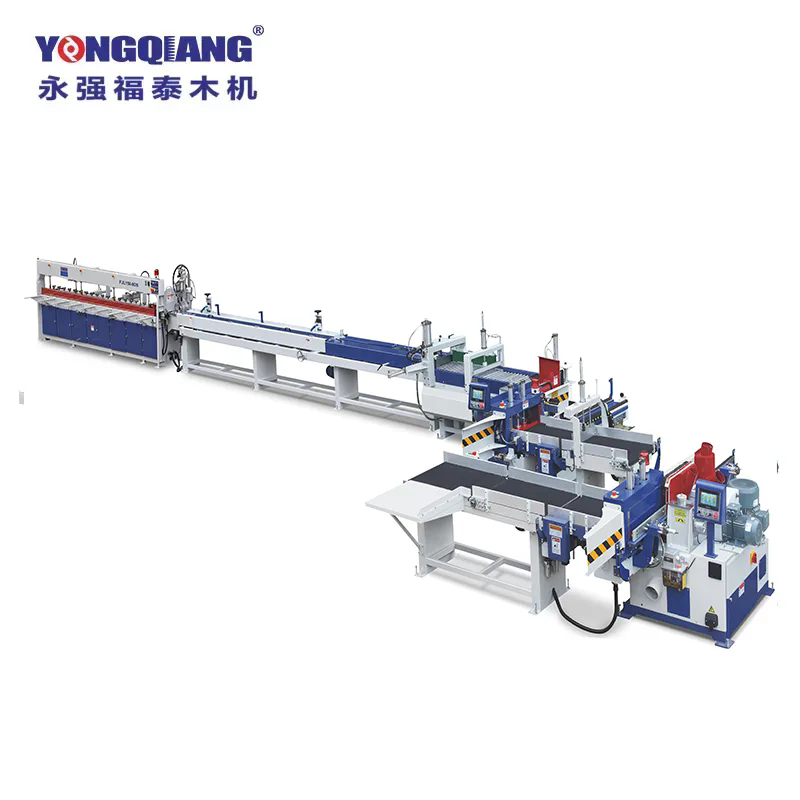
Global solid wood furniture factories and timber construction manufacturers are trapped in two core profit squeeze issues: rising log prices and severe labor shortages. Traditional semi-automatic finger joint production requires multiple skilled workers for feeding, gluing and pressing, with low processing consistency and massive short wood scraps discarded as waste, directly compressing factory gross margins. Many small-scale discrete finger joint equipment fails to form a complete closed production chain, resulting in frequent line downtime and unstable finished wood strength that cannot meet export construction material standards. Yongqiang Futai’s new generation Fully Automatic Finger Jointing Lines integrates all processing procedures under one PLC intelligent control system, helping wood processing enterprises maximize scrap recycling rate, slash manual dependence and produce high-strength spliced lumber compliant with international export norms.
1. Closed-loop full-process automation cuts manual input and human error loss fundamentally
Traditional segmented finger joint equipment needs 4–6 skilled operators to separately complete feeding, end trimming, tooth milling, gluing and pressing procedures, with inconsistent operation rhythm leading to frequent defective wood blanks. This integrated production line realizes one-time raw material feeding and unmanned continuous operation, covering automatic sorting, double-end comb tooth forming, quantitative gluing, hydraulic docking, constant temperature curing and CNC fixed-length cutting all the way to finished palletizing. Only one patrol staff is required to monitor the whole unit, cutting labor input by over 70%. Uniform servo transmission and sensor feedback eliminate dimensional deviations caused by manual operation, greatly reducing finished product rejection rates and daily labor payroll expenditure for medium and large wood factories.
2. High-precision tooth forming & constant pressure docking guarantees export-grade lumber structural strength
Low-cost finger joint machines suffer from unstable tooth precision and uneven gluing layers; spliced wood easily cracks and deforms under load, failing structural timber export inspection and triggering batch return losses. The production line controls comb tooth tolerance within ±0.02mm with high-speed spindle units, minimizing wood fiber damage during cutting. Intelligent quantitative gluing systems avoid glue overflow or insufficient coating, while 7000kg constant hydraulic thrust ensures tight interlocking between tooth profiles. The tensile and bending strength of finished spliced lumber reaches more than 90% of solid timber, fully satisfying the load-bearing requirements of prefabricated wooden structures, solid wood furniture frames and export integrated wood substrates, helping manufacturers pass CE and ISO third-party product audits smoothly.
3. Full-range raw material compatibility raises scrap utilization by 30%–50% to offset log cost hikes
Conventional finger joint machines only support long standard lumber and discard a large amount of 150mm+ short scraps, cutting blocks and defective wood produced during cutting, generating huge raw material waste. This intelligent line accepts all mainstream soft and hardwood raw materials including pine, fir, poplar and rubberwood, with processable cross-section ranging from 20×20mm to customized oversized sizes. Short leftover wood from cutting workshops, construction waste wood and offcut blocks can all be spliced into standard long lumber of 400–6000mm, turning waste materials into salable finished products. Under the background of continuous global log price fluctuations, improved material utilization directly reduces monthly timber procurement costs and creates extra revenue streams from waste recycling.
4. Low-noise sealed dust structure meets international factory environmental supervision standards
Many outdated finger joint equipment lacks complete dust removal design, generating large amounts of flying sawdust and operating noise exceeding 85dB, which easily triggers local environmental fines and worker health complaints. The whole line adopts fully sealed protective covers matched with central dust removal interfaces, centralized collection of wood chips without workshop dust accumulation. Optimized spindle and conveyor transmission structure controls overall running noise below 70dB, complying with EU factory noise emission limits. Water-free, waste-free processing workflow avoids sewage discharge, eliminating environmental inspection hidden troubles for export-oriented wood processing plants and helping factories pass overseas customer factory audits smoothly.
5. Unified PLC intelligent control simplifies operation and cross-material parameter switching
Discrete single-function finger joint machines require professional technicians to adjust multiple mechanical parameters when switching wood types and specifications, causing long production line downtime. The closed-loop line adopts a unified PLC touch control system; operators only input wood thickness, target length and material hardness parameters on the panel to complete one-click mode switching. Built-in multi-wood material preset programs for softwood and hardwood eliminate repeated mechanical debugging. Complete real-time fault alarm prompts quickly locate jamming, glue shortage and abnormal pressure issues, lowering the technical threshold for ordinary production workers to operate large-scale integrated equipment.
6. Factory full-load testing & global localized after-sales eliminate cross-border equipment operation risks
Most small machinery suppliers only conduct simple static inspection before delivery, lacking full-load continuous operation testing, leading to frequent failures after customers receive the line and long waiting periods for overseas maintenance personnel. Every set of Yongqiang Futai finger joint line undergoes 72-hour uninterrupted full-load aging testing, verifying stability under long-term continuous production and adapting to different regional voltage and climate environments. The factory holds multiple invention patents and CE, ISO9001 certification, with localized after-sales teams covering over 60 countries. Complete spare parts inventory and remote online debugging services shorten equipment failure downtime for overseas wood factories, supporting long-term stable mass production of furniture and structural timber.