

What Core Hardware Advantages Separate Premium Finger Joint Presses From Budget Assembly Models?
Many medium and large wood processing factories invest in low-cost finger joint presses only to face recurring production losses after short run times. Uneven hydraulic thrust creates gaps and rebound on spliced timber, frequent oil leakage raises maintenance labor, narrow material compatibility limits order expansion, and incomplete safety structures trigger workshop management risks. After three decades focused on wood joint equipment R&D, Yongqiang Futai designs industrial-grade finger joint presses with integrated stabilized hydraulic systems, thickened welded frames and multi-mode automatic control, targeting the core failure points of generic pressing equipment and creating long-cycle stable production conditions for furniture, construction timber and waste wood recycling plants worldwide.
1. Constant pressure hydraulic system eliminates joint rebound and unqualified finished timber waste
Cheap assembled presses adopt simple unregulated hydraulic stations with unstable thrust output. During continuous pressing, pressure fluctuates up and down, leading to incomplete tooth interlock, glue layer separation and wood springback after release, generating large batches of rejected spliced boards. This machine’s customized pressure stabilization unit supports freely adjustable dwell time and balanced full-surface thrust up to 7000kg. Every section of timber receives consistent clamping force without local over-compression cracking or insufficient bonding gaps. Finished finger joint lumber maintains tensile strength comparable to solid logs, cutting defective product rates and raw material waste caused by unstable pressing performance.
2. Thickened integral steel frame realizes 24-hour uninterrupted heavy-load operation
Light thin-welded machine frames vibrate severely under long-term hydraulic impact, gradually deforming the workbench and shifting positioning benchmarks, which forces frequent equipment calibration and line shutdown. The whole body of this finger joint press adopts national standard thick steel one-time welding forming, with reinforced stress support beams at all pressure bearing positions. Even under round-the-clock mass pressing tasks, the frame stays free of deformation or shaking. Brand-name hydraulic pumps, sealing rings and drive motors are matched for core components, drastically reducing oil seepage, component burnout and unplanned maintenance downtime for year-round production workshops.
3. Dual automatic & manual modes match factories of different production scales
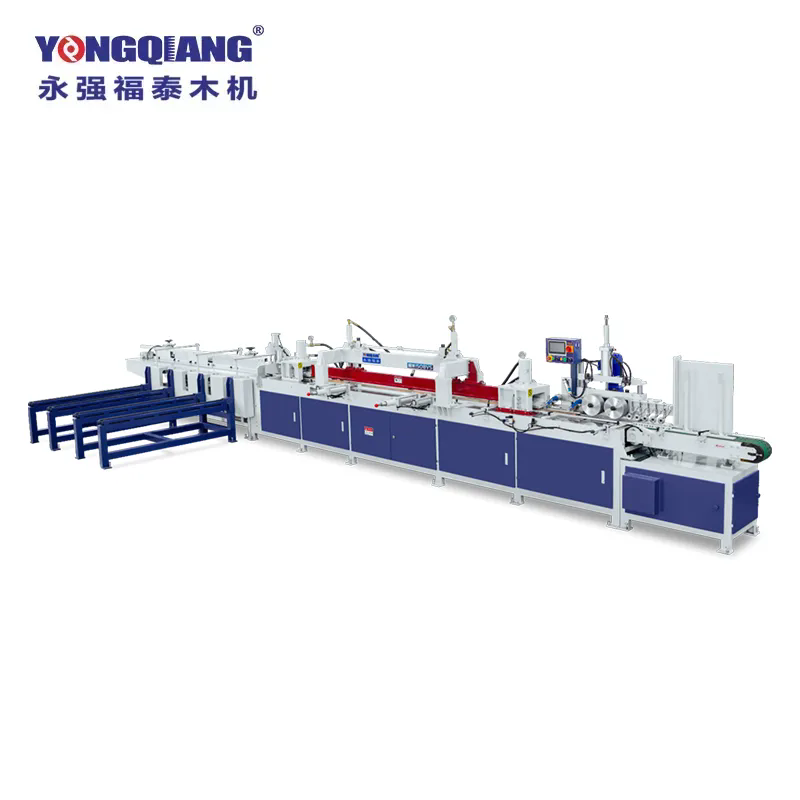
Most single-function presses cannot adapt flexible production demands: small batch workshops only need semi-automatic simple operation, while large integrated production lines require fully automatic linkage feeding and discharging. Yongqiang Futai’s press reserves two complete operation architectures for customer selection. Semi-automatic versions use intuitive physical switches with low learning barriers for small wood workshops; full-automatic models equip touch PLC panels, realizing one-click feeding, clamping, pressure holding and automatic ejection, seamlessly docking front tooth shapers and gluing machines. Factories can select configurations according to daily output without purchasing two separate pressing devices to cover mixed order production.
4. Wide material compatibility unlock diversified profit channels for wood manufacturers
Ordinary presses only support single softwood specifications and cannot process hardwood, wide boards or varying-thickness wood squares, limiting factory order types and revenue sources. This equipment accommodates pine, fir, poplar, oak, birch and multiple hard/soft wood species, covering raw materials from thin decorative strips to thick load-bearing construction timbers. Processable cross-section ranges from 20×20mm to customized oversized sizes, capable of lengthening short scraps, trimming furniture frame blanks and splicing building integrated wood. One single press handles waste recycling, furniture substrate and engineering timber orders simultaneously, maximizing the utilization rate of existing factory production space.
5. Compact footprint and full safety configuration simplify standardized workshop layout
Oversized heavy presses demand special reinforced foundation construction, while unprotected exposed hydraulic rods create occupational safety hazards during worker operation. Optimized compact structural design reduces overall occupied area, allowing direct flat ground placement without civil transformation costs; built-in full surrounding safety guard plates, emergency stop switches and hand anti-pinch sensors block all operational hidden dangers. Running noise is controlled at low levels without extra sound insulation renovation, fully complying with EU and global factory occupational health inspection standards, helping wood factories smoothly pass overseas customer factory audits.
6. CE & ISO certified customized equipment supports cross-border engineering bulk orders
Small assembly machinery factories lack complete export certification documents, resulting in customs detention and order delays for overseas buyers. All Yongqiang Futai finger joint presses pass CE mechanical safety and ISO9001 quality system certification, with complete factory inspection reports, parameter test sheets and shipment qualification certificates provided per unit. Non-standard dimensional, power and pressure customization services are available for special production line matching requirements. Global localized after-sales teams deliver remote debugging guidance and lifetime spare parts supply, eliminating long-distance maintenance waiting losses for cross-border wood processing clients.